 Add to Chrome
 Add to Firefox
 Add to Edge
H-Flow: Self-supervised Human Scene Flow via Physics-inspired Joint Multi-modal Learning
May 21, 2026
Parametric human models capture global pose but cannot represent the non-rigid surface dynamics of clothing and soft tissue. Generic scene flow estimates dense motion but breaks down on articulated bodies, where pixel-level supervision is also intractable to acquire. We introduce H-Flow, a dense human scene flow that captures both skeletal kinematics and surface deformation. A unified multi-head transformer estimates flow from monocular video, jointly predicting pose and depth as companion outputs. The challenge lies in the lack of supervision. In place of unattainable labels, we anchor the network in the physics of human motion, encoding geometric, structural, and biomechanical priors as cross-modal training objectives. We further introduce DynAct4D, a high-fidelity synthetic benchmark providing dense flow annotations across diverse subjects, garments, and motions. On standard benchmarks, H-Flow outperforms scene-flow and parametric baselines, and generalizes zero-shot to in-the-wild video. Code, models, and the DynAct4D benchmark will be released upon publication

Spatially Prompted Visual Trajectory Prediction for Egocentric Manipulation
May 19, 2026Robotic manipulation is often specified through language instructions or task identifiers, yet cluttered environments with similar objects are better handled by spatially indicating what to move and where to place it. Addressing the vision-centric challenge of object and goal specification, we present, to the best of our knowledge, the first formalization of Spatially Prompted Visual Trajectory Prediction (SP-VTP). This novel setting utilizes initial spatial prompts (like bounding boxes or points) to define task objectives, tasking the model with forecasting future end-effector trajectories from egocentric streams. To study this problem, we collect and annotate EgoSPT, a dataset of egocentric spatially prompted manipulation trajectories with first-frame object and target grounding annotations and recovered 3D end-effector motion. SP-VTP is challenging because the task specification is static, while the scene configuration evolves over time. To solve this problem, we propose SPOT(Spatially Prompted Object-Target Policy), which combines a task encoder for first-frame visual and coordinate spatial prompts, an observation encoder for current visual and history context, and a trajectory generator for future end-effector motion. Experiments under strict scene-level splits show that SPOT improves cross-scene trajectory prediction over non-prompted or single-source prompted baselines. Together, EgoSPT and SPOT establish a new spatial prompting problem SP-VTP, as a simple and scalable task condition for egocentric manipulation.
From 3D Pose to Prose: Biomechanics-Grounded Vision--Language Coaching
Mar 27, 2026We present BioCoach, a biomechanics-grounded vision--language framework for fitness coaching from streaming video. BioCoach fuses visual appearance and 3D skeletal kinematics, through a novel three-stage pipeline: an exercise-specific degree-of-freedom selector that focuses analysis on salient joints; a structured biomechanical context that pairs individualized morphometrics with cycle and constraint analysis; and a vision--biomechanics conditioned feedback module that applies cross-attention to generate precise, actionable text. Using parameter-efficient training that freezes the vision and language backbones, BioCoach yields transparent, personalized reasoning rather than pattern matching. To enable learning and fair evaluation, we augment QEVD-fit-coach with biomechanics-oriented feedback to create QEVD-bio-fit-coach, and we introduce a biomechanics-aware LLM judge metric. BioCoach delivers clear gains on QEVD-bio-fit-coach across lexical and judgment metrics while maintaining temporal triggering; on the original QEVD-fit-coach, it improves text quality and correctness with near-parity timing, demonstrating that explicit kinematics and constraints are key to accurate, phase-aware coaching.
ViT-AdaLA: Adapting Vision Transformers with Linear Attention
Mar 17, 2026Vision Transformers (ViTs) based vision foundation models (VFMs) have achieved remarkable performance across diverse vision tasks, but suffer from quadratic complexity that limits scalability to long sequences. Existing linear attention approaches for ViTs are typically trained from scratch, requiring substantial computational resources, while linearization-based methods developed for large language model decoders do not transfer well to ViTs. To address these challenges, we propose ViT-AdaLA, a novel framework for effectively adapting and transferring prior knowledge from VFMs to linear attention ViTs. ViT-AdaLA consists of three stages: attention alignment, feature alignment, and supervised fine-tuning. In the attention alignment stage, we align vanilla linear attention with the original softmax-based attention in each block to approximate the behavior of softmax attention. However, residual approximation errors inevitably accumulate across layers. We mitigate this by fine-tuning the linearized ViT to align its final-layer features with a frozen softmax VFM teacher. Finally, the adapted prior knowledge is transferred to downstream tasks through supervised fine-tuning. Extensive experiments on classification and segmentation tasks demonstrate the effectiveness and generality of ViT-AdaLA over various state-of-the-art linear attention counterpart.
IndustryEQA: Pushing the Frontiers of Embodied Question Answering in Industrial Scenarios
May 27, 2025Existing Embodied Question Answering (EQA) benchmarks primarily focus on household environments, often overlooking safety-critical aspects and reasoning processes pertinent to industrial settings. This drawback limits the evaluation of agent readiness for real-world industrial applications. To bridge this, we introduce IndustryEQA, the first benchmark dedicated to evaluating embodied agent capabilities within safety-critical warehouse scenarios. Built upon the NVIDIA Isaac Sim platform, IndustryEQA provides high-fidelity episodic memory videos featuring diverse industrial assets, dynamic human agents, and carefully designed hazardous situations inspired by real-world safety guidelines. The benchmark includes rich annotations covering six categories: equipment safety, human safety, object recognition, attribute recognition, temporal understanding, and spatial understanding. Besides, it also provides extra reasoning evaluation based on these categories. Specifically, it comprises 971 question-answer pairs generated from small warehouse and 373 pairs from large ones, incorporating scenarios with and without human. We further propose a comprehensive evaluation framework, including various baseline models, to assess their general perception and reasoning abilities in industrial environments. IndustryEQA aims to steer EQA research towards developing more robust, safety-aware, and practically applicable embodied agents for complex industrial environments. Benchmark and codes are available.
H-MoRe: Learning Human-centric Motion Representation for Action Analysis
Apr 14, 2025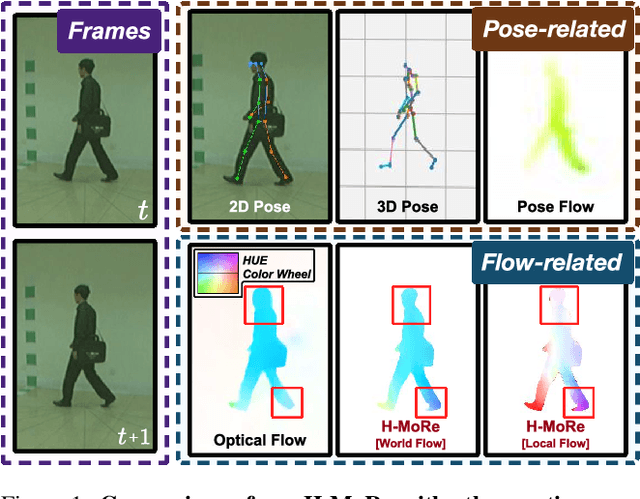
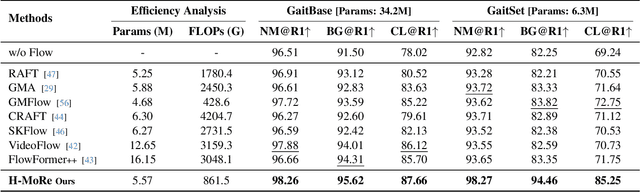
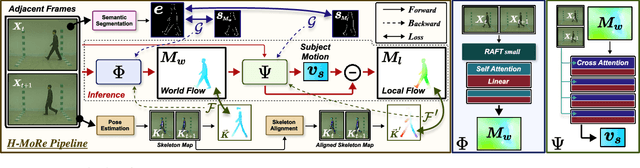
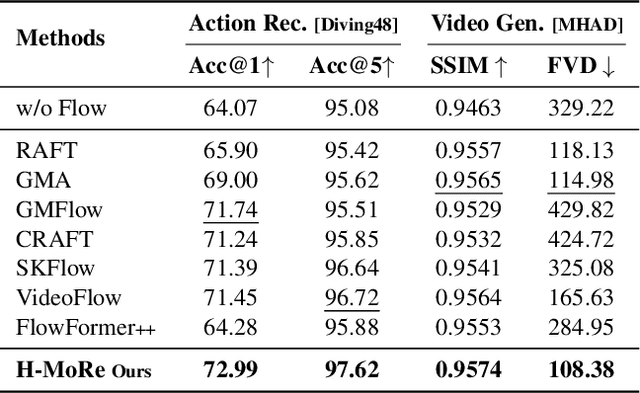
In this paper, we propose H-MoRe, a novel pipeline for learning precise human-centric motion representation. Our approach dynamically preserves relevant human motion while filtering out background movement. Notably, unlike previous methods relying on fully supervised learning from synthetic data, H-MoRe learns directly from real-world scenarios in a self-supervised manner, incorporating both human pose and body shape information. Inspired by kinematics, H-MoRe represents absolute and relative movements of each body point in a matrix format that captures nuanced motion details, termed world-local flows. H-MoRe offers refined insights into human motion, which can be integrated seamlessly into various action-related applications. Experimental results demonstrate that H-MoRe brings substantial improvements across various downstream tasks, including gait recognition(CL@R1: +16.01%), action recognition(Acc@1: +8.92%), and video generation(FVD: -67.07%). Additionally, H-MoRe exhibits high inference efficiency (34 fps), making it suitable for most real-time scenarios. Models and code will be released upon publication.
Are We Merely Justifying Results ex Post Facto? Quantifying Explanatory Inversion in Post-Hoc Model Explanations
Apr 11, 2025Post-hoc explanation methods provide interpretation by attributing predictions to input features. Natural explanations are expected to interpret how the inputs lead to the predictions. Thus, a fundamental question arises: Do these explanations unintentionally reverse the natural relationship between inputs and outputs? Specifically, are the explanations rationalizing predictions from the output rather than reflecting the true decision process? To investigate such explanatory inversion, we propose Inversion Quantification (IQ), a framework that quantifies the degree to which explanations rely on outputs and deviate from faithful input-output relationships. Using the framework, we demonstrate on synthetic datasets that widely used methods such as LIME and SHAP are prone to such inversion, particularly in the presence of spurious correlations, across tabular, image, and text domains. Finally, we propose Reproduce-by-Poking (RBP), a simple and model-agnostic enhancement to post-hoc explanation methods that integrates forward perturbation checks. We further show that under the IQ framework, RBP theoretically guarantees the mitigation of explanatory inversion. Empirically, for example, on the synthesized data, RBP can reduce the inversion by 1.8% on average across iconic post-hoc explanation approaches and domains.
Window Token Concatenation for Efficient Visual Large Language Models
Apr 05, 2025To effectively reduce the visual tokens in Visual Large Language Models (VLLMs), we propose a novel approach called Window Token Concatenation (WiCo). Specifically, we employ a sliding window to concatenate spatially adjacent visual tokens. However, directly concatenating these tokens may group diverse tokens into one, and thus obscure some fine details. To address this challenge, we propose fine-tuning the last few layers of the vision encoder to adaptively adjust the visual tokens, encouraging that those within the same window exhibit similar features. To further enhance the performance on fine-grained visual understanding tasks, we introduce WiCo+, which decomposes the visual tokens in later layers of the LLM. Such a design enjoys the merits of the large perception field of the LLM for fine-grained visual understanding while keeping a small number of visual tokens for efficient inference. We perform extensive experiments on both coarse- and fine-grained visual understanding tasks based on LLaVA-1.5 and Shikra, showing better performance compared with existing token reduction projectors. The code is available: https://github.com/JackYFL/WiCo.
Visual Large Language Models for Generalized and Specialized Applications
Jan 06, 2025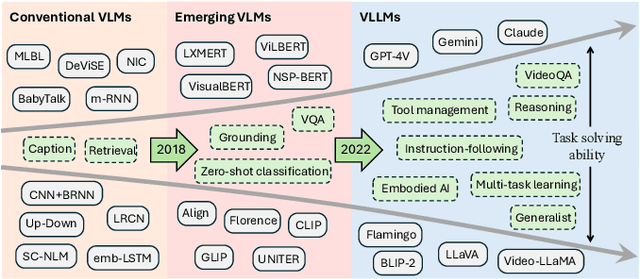
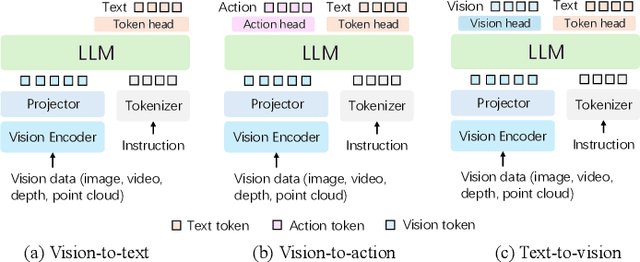

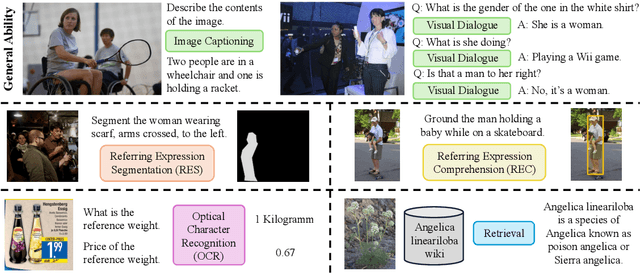
Visual-language models (VLM) have emerged as a powerful tool for learning a unified embedding space for vision and language. Inspired by large language models, which have demonstrated strong reasoning and multi-task capabilities, visual large language models (VLLMs) are gaining increasing attention for building general-purpose VLMs. Despite the significant progress made in VLLMs, the related literature remains limited, particularly from a comprehensive application perspective, encompassing generalized and specialized applications across vision (image, video, depth), action, and language modalities. In this survey, we focus on the diverse applications of VLLMs, examining their using scenarios, identifying ethics consideration and challenges, and discussing future directions for their development. By synthesizing these contents, we aim to provide a comprehensive guide that will pave the way for future innovations and broader applications of VLLMs. The paper list repository is available: https://github.com/JackYFL/awesome-VLLMs.
LiDAR-based End-to-end Temporal Perception for Vehicle-Infrastructure Cooperation
Nov 22, 2024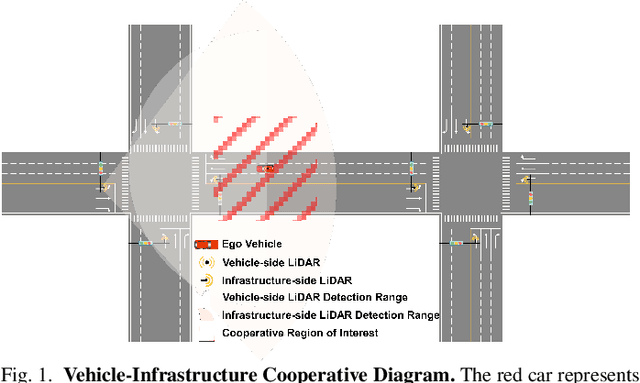
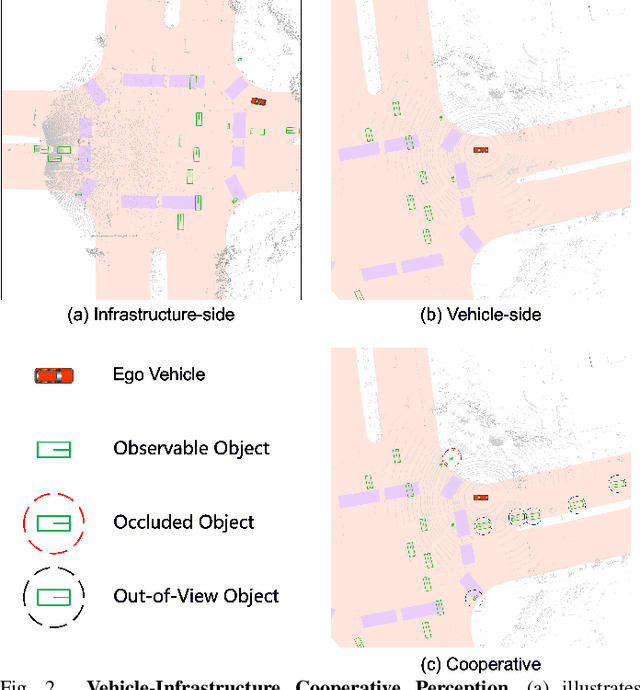
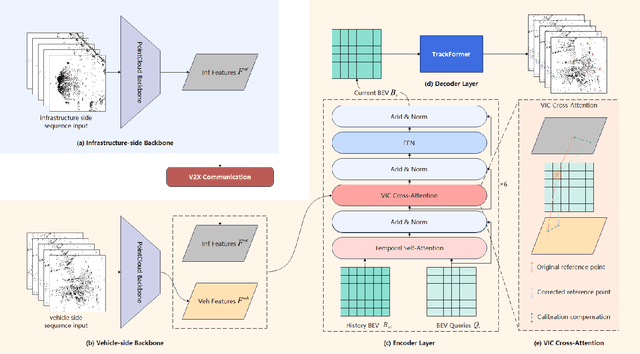
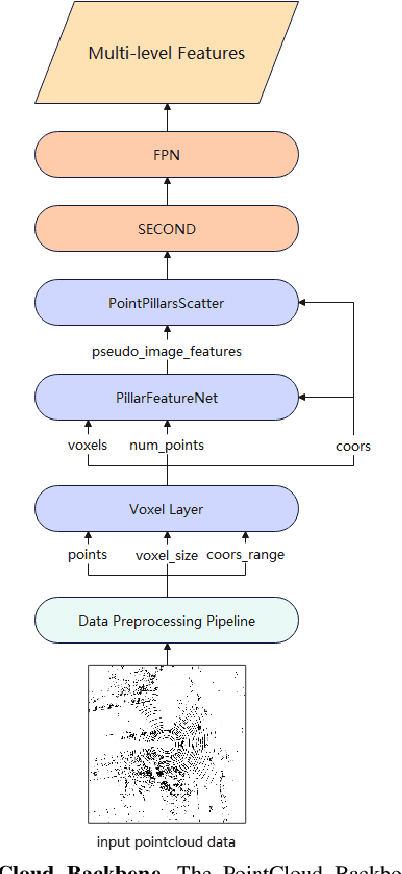
Temporal perception, the ability to detect and track objects over time, is critical in autonomous driving for maintaining a comprehensive understanding of dynamic environments. However, this task is hindered by significant challenges, including incomplete perception caused by occluded objects and observational blind spots, which are common in single-vehicle perception systems. To address these issues, we introduce LET-VIC, a LiDAR-based End-to-End Tracking framework for Vehicle-Infrastructure Cooperation (VIC). LET-VIC leverages Vehicle-to-Everything (V2X) communication to enhance temporal perception by fusing spatial and temporal data from both vehicle and infrastructure sensors. First, it spatially integrates Bird's Eye View (BEV) features from vehicle-side and infrastructure-side LiDAR data, creating a comprehensive view that mitigates occlusions and compensates for blind spots. Second, LET-VIC incorporates temporal context across frames, allowing the model to leverage historical data for enhanced tracking stability and accuracy. To further improve robustness, LET-VIC includes a Calibration Error Compensation (CEC) module to address sensor misalignments and ensure precise feature alignment. Experiments on the V2X-Seq-SPD dataset demonstrate that LET-VIC significantly outperforms baseline models, achieving at least a 13.7% improvement in mAP and a 13.1% improvement in AMOTA without considering communication delays. This work offers a practical solution and a new research direction for advancing temporal perception in autonomous driving through vehicle-infrastructure cooperation.